A working definition
An AI live stream is a broadcast whose picture — and sometimes its sound — is being generated by a model while the stream is on air. The channel does not play back a file; it produces the next moment of video shortly before you see it. If the model stopped, the stream would freeze or end. That is the test we use for the AI Live Streams category, and it deliberately excludes two things people often mean instead: human streams that use AI for captions, clipping or chat moderation, and channels that loop a batch of pre-rendered AI clips.
The definition does not require an audience to be involved. A channel can generate continuously from a standing prompt with nobody watching. But most public channels today are audience-directed, because letting viewers pick the next scene is the most obvious thing to do with a generator that responds in seconds.
How continuous generation works today
Almost every public AI live stream in 2026 is clip-based. A model produces a short segment — typically five to fifteen seconds — and a pipeline stitches segments together into a standard stream that any browser can play. The trick that makes this possible is speed: the model must finish the next clip before the current one ends. fal's H3 Max, a post-trained version of MiniMax H3, is the model behind the channels we currently track, and its operator states that it produces a five-second clip in around three seconds.
With that margin, a channel keeps a buffer of two or three upcoming clips. While one plays, the next is being generated from whatever the queue selected, and the one after that is waiting. Viewers see the seams — a hard cut every fifteen seconds, characters that drift between segments — because each clip is generated more or less independently, with only the previous prompt or scene description carried forward. We label this continuity type prompt-linked clips. Research systems that generate frame by frame exist, but they are not what most people can watch right now.
The formats you will actually find
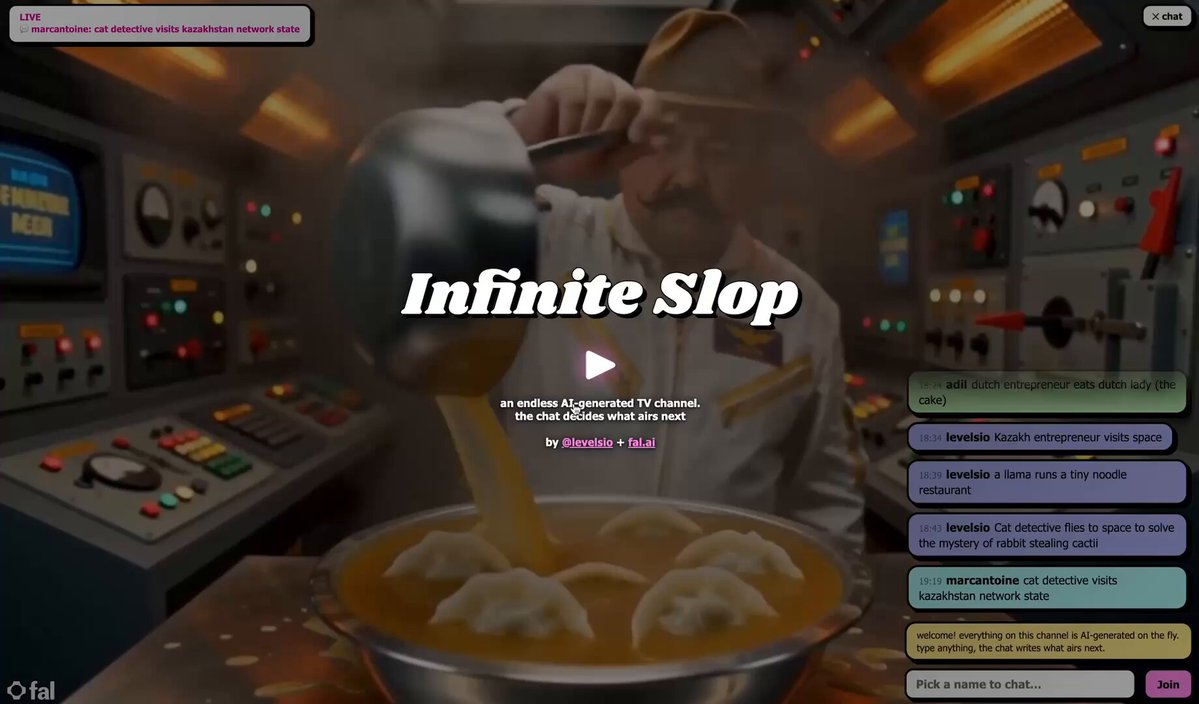
Open-queue shows let anyone type an idea; votes order the queue and the top entry becomes the next clip. Infinite Slop is the reference example: one channel, one chat, a public queue and an unmistakable sense of chaos. Ruled-world channels put a standing system prompt in charge — a cast, a setting, a tone — and let the audience steer only within those rules. fal.live's channels take this approach and pitch it to creators as a way to keep a show recognisably theirs. Beyond those, the Continuous AI Video category covers channels that generate without audience input, and adjacent categories track interactive worlds and live camera transformation, which are related technologies rather than broadcasts.
How to tell whether a channel is really live
Marketing copy will tell you a channel is 24/7. That is a claim, not a fact. Three things are worth checking. First, does the page expose a stream you can inspect — an HLS playlist whose segment counter keeps rising is hard to fake. Second, does the operator publish a status feed, and does it carry fresh timestamps and pipeline markers such as “now generating” and “now playing”? Third, when you open the player, does something new appear that could not have been pre-rendered, such as a scene from a prompt you just watched enter the queue?
This site applies the first two checks automatically for channels that expose them, and shows a red LIVE label only when a public detector confirmed output within the last hour. Where no public signal exists, we say Unverified rather than guessing; a website that loads is not evidence of a broadcast. The methodology page describes the rules in detail.
Why the category is worth following
AI live streams are where generation speed becomes a product rather than a benchmark. The channels running today are rough, but they demonstrate a loop — prompt, vote, generate, broadcast — that did not work at all a year earlier, and they surface the real problems of the format: moderation of public prompts, continuity between segments, the cost of generating around the clock, and how to keep an audience once the novelty fades. Watching how the first channels handle those problems is the best way to understand what the next ones will look like.